
An advisory white paper | TechReady.io | Online Readiness, LLC | July 2026
Every retention model, from early-alert dashboards to the newest AI built directly into the LMS, shares one blind spot: it cannot see the student who never starts.
This paper is about that blind spot, why it exists, and one solution that closes it. We offer this as people who run a longitudinal device-readiness platform, but the argument does not depend on our product. It depends on how these systems work.
Retention AI is only as good as its earliest input
Retention analytics have improved quickly. Predictive early-alert systems, engagement models, and new LMS-native AI agents can flag a struggling student earlier and more accurately than they could a few years ago. But every one of these systems shares a structural limit it cannot fix: each can only act on students who have already generated behavior for it to read. The model is only as good as its earliest input, and for these systems that input arrives later than the moment that decides many outcomes.
The cold-start problem, applied to retention
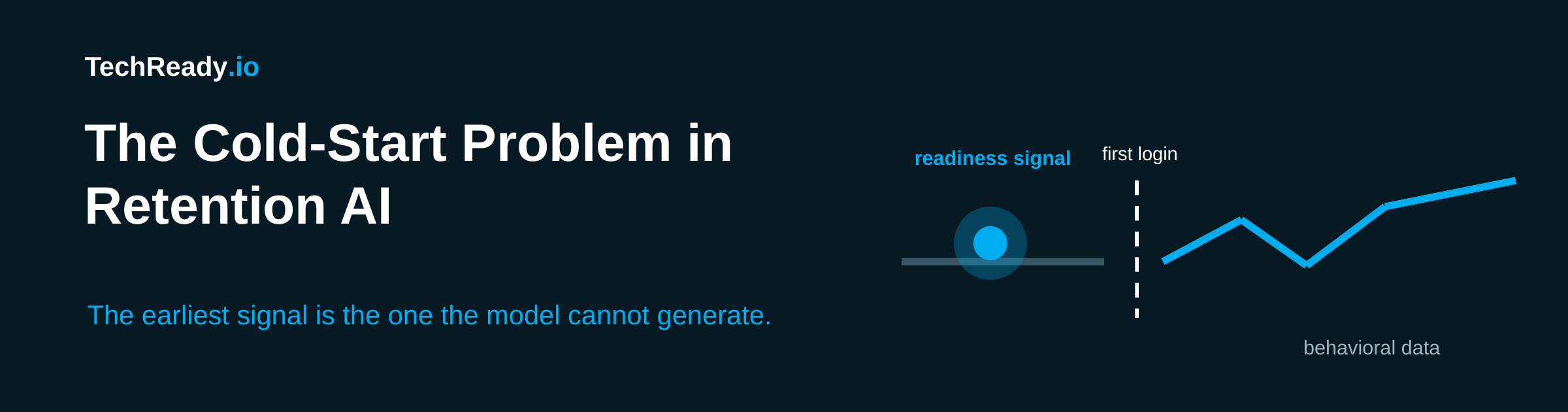
In machine learning, the cold-start problem describes what happens when a system must make a decision about an entity for which it has no prior data. A recommender cannot recommend to a brand-new user; a scoring model cannot score a record with no history. Retention AI has a cold-start problem of its own, and it is most acute at the moment that matters most: the first days of enrollment. Before a student submits an assignment, opens the LMS, or misses a deadline, there is no behavioral trace to learn from. The student who hits a barrier in week one and quietly disappears never generates the behavior that would have flagged them. They are invisible to the model precisely when an intervention would have been easiest and least expensive.
Retention products catch week five; the barrier happened in week zero.
Two different classes of signal
The reason this blind spot is structural and not a tuning problem is that retention models run on behavioral signals and the earliest risk is not behavioral. Logins, clicks, submissions, and time-on-task are all behaviors; they require the student to already be active. A student’s technical readiness, whether their device, browser, operating system, and connection can actually run the course, is a precondition, not a behavior. It is knowable at intake, before the first session, before any behavior exists. It belongs to a different class of data, one that behavioral systems are not built to capture, because the readiness signal sits upstream of everything these systems observe.
Why the model cannot generate this signal on its own
A fair objection is that a good enough model should be able to infer a device problem from later behavior. It cannot, for a plain reason: the students with the most severe readiness barriers generate the least behavior. The student whose browser cannot hold a login session, or whose device cannot load the course, produces almost no signal to infer from. And a week-zero device state cannot be reconstructed after the fact. By the time there is any behavior to log, the barrier has either been overcome or has already produced the withdrawal. The signal is not hidden in the behavioral data waiting to be modeled. It is absent from this data; it has to be captured at the door, or it is gone.
What the signal is, and what it is not
The pre-behavioral readiness signal is a measured fact about the device at scan time: an outdated browser, an out-of-date operating system, a connection below what the course requires, a configuration that will block the tools the program depends on. It is measured, not modeled. TechReady does not predict who will drop out; a device scan cannot defensibly do that. What the scan produces is a transparent, rules-based flag: this student, at sign-on, has a fixable condition standing between them and their first class. Because the condition is fixable, this flag includes a fix the student can act on, so detection leads to resolution on the spot. No personally identifiable information changes hands; an external ID is re-identified only inside the school’s own boundary. It is not only the earliest input a retention model can have, it is the cleanest. What the institution does with that flag, and how it weighs it in any retention model, stays with the institution.
The signal is also durable and real, not a hypothesis. Across 8.5 years and 131,418 scans at 19 institutions, roughly six in ten students still arrive before their first session with at least one fixable readiness issue. About four in ten arrive with an outdated browser and about one in three with an out-of-date operating system. Bandwidth, once the dominant barrier, has largely receded (from 47 percent of scans below the old 25 Mbps benchmark to 13 percent), but browser and operating-system hygiene have not improved in nearly a decade. Independent literature is consistent with this: a 2024 systematic review of 110 studies found technology-related factors account for roughly 18% to 20% of all identified online-dropout factors, one of the top-five categories.
The point is not that devices predict dropout, but that a real, fixable, pre-behavioral condition is present in a majority of incoming students and is invisible to every system that waits for behavior. Whether surfacing and fixing that condition measurably improves persistence is a separate question, and a retrospective outcome-linkage study now underway with a long-tenured partner institution is built to answer it. Until it reports, we treat the retention effect as reasoned from the data, not proven by it.
The blind spot sits where the stakes are highest
The students most likely to arrive with a device barrier (first-generation students, working adults, and lower-income enrollees on older or shared hardware) are the same students retention programs most need to reach and that federal accountability now scrutinizes most closely. Under the STATS Earnings Accountability rule (finalized July 1, 2026; effective July 1, 2027) and the parallel move toward outcomes-based accreditation, institutions increasingly have to document the intervention behind their retention numbers, not just report the numbers. The earliest documented, dated intervention a school can produce is the one at intake: the moment it detected a barrier, handed the student a fix, and recorded that it happened. So the cold-start signal is not only the input a retention model lacks; it is also the first entry in the evidence trail reviewers now expect.
A sensor layer, not another model
This is why readiness measurement complements retention AI rather than competing with it. The scan does not replace early-alert systems or LMS analytics; it feeds them the one data point they cannot generate for themselves, at the moment it first exists. In operational terms, the moment a student completes a scan, the result can be passed to your early-alert or student-success platform through a standard API feed, before any behavioral signal exists for those systems to read. A brain needs eyes. The readiness scan is what the model should see first.
It is fair to ask why a platform could not simply build this sensor itself. The mechanism is easy to imagine; the asset behind it is not. A readiness signal is only as useful as the history that tells you what it means, what a given browser, operating system, or connection actually implies about a student’s ability to begin, and that history is the product of 8.5 years and 131,418 scans across 19 institutions, among the longest continuous readiness records in higher education. Our core method is covered by two granted US patents. A model can be pointed at readiness data the moment it exists, but the data, and the years it takes to make that data mean something, are not something a new sensor produces on its first day.
Questions worth asking if you are building or buying retention AI
What does our retention model see in a student’s first week, before any behavior exists, and what does it do with the students it cannot yet see?
If a student never logs in, what in our current stack notices, and when?
Do we capture any pre-behavioral readiness signal at intake, and does it reach the systems that act on risk?
Can we show, with dated data, that we identified and addressed the technical barriers most likely to end a student’s term before it started?
Where this leaves you
A readiness scan is a small thing at the very start of a much longer climb. It does not retain a student; the institution does that and the student does the work. What it does is help make sure the climb can begin and leave a dated record that it did. For a retention model, that record is the earliest input it will ever get, and the one it cannot manufacture for itself. If you want to see what your own incoming students arrive with, before their first class and before a retention model has anything to read, the fastest way is to look: a 30-day, 500-scan pilot on one incoming cohort, no installation, no commitment, no PII, and the data is yours. Scan your own device now at bbt26.techready.io, or reach us at info@techready.io to set up a pilot on one incoming cohort.
Data and claims note