
ADVISORY BRIEFING · FOR ONLINE PROGRAM LEADERS, PROVOSTS, AND CIOs
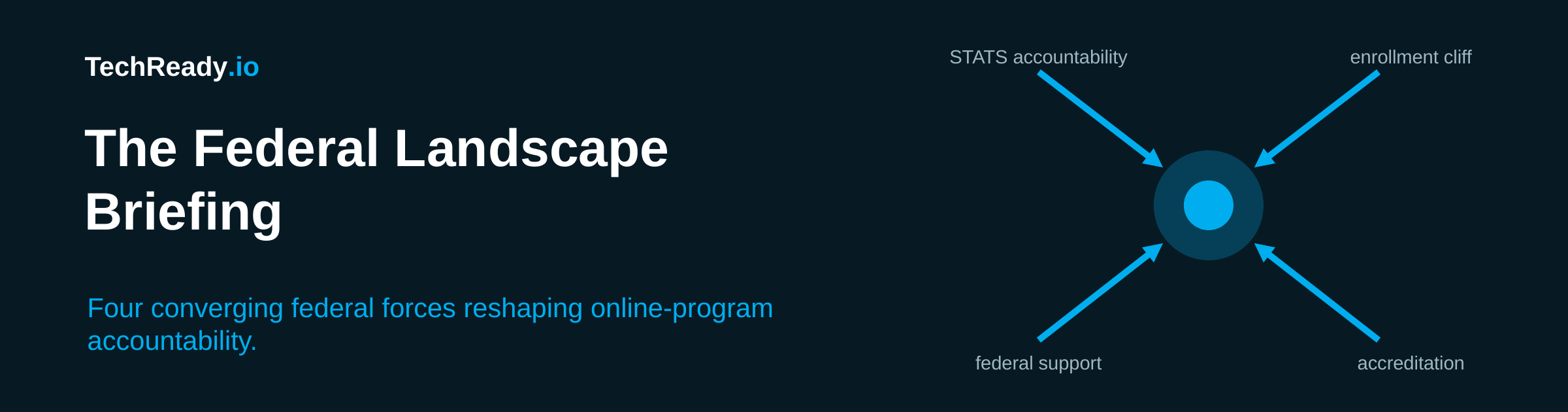
Four federal forces converging on the same operational requirement: document your students’ readiness and what you did about it, or be judged on outcomes you didn’t shape.
Executive summary
The federal landscape for online programs has shifted from rewarding enrollment to demanding evidence of outcomes, and four forces are converging on the same requirement.
First, earnings accountability now carries direct Title IV consequences. The Department of Education’s STATS Earnings Accountability rule, finalized July 1, 2026 and effective July 1, 2027, judges programs on what their graduates earn, and its adjacent tests penalize attrition even where the earnings metric itself cannot see it. Second, the demographic enrollment cliff has arrived, making online programs the principal path to growth and raising the stakes on the instrumentation behind them. Third, federal student support is contracting, from the shift of TRIO administration to the Department of Labor to the elimination of Grad PLUS for new borrowers, leaving institutions more exposed to the cost of attrition with less external cushion to absorb it. Fourth, accreditors are moving in unison toward outcomes-based review, where completion, retention, and time-to-degree are the evidence reviewers examine.
The through-line is a single shift: the burden of proof for student outcomes is moving onto institutions, and that proof must be operational and evidence-backed, not narrative. A retention figure alone is increasingly insufficient; reviewers now want the documented trail behind it, where you measured, how you intervened, and what the data showed.
This briefing takes each of those four forces in turn, explains what it means for online programs specifically, and offers a set of operational questions worth raising inside your institution over the next 6 to 12 months.
We write it as people who run a longitudinal device-readiness platform, but it is intended as institutional advisory, not a pitch. The starting question for any leader navigating this landscape is the same regardless of vendor: can you defend your retention outcomes with evidence when reviewers ask?
-
Earnings accountability is now linked to Title IV eligibility
The One Big Beautiful Bill Act (OBBBA), signed July 4, 2025, established an outcomes-based federal funding framework with direct consequences. Undergraduate programs lose Title IV and Pell eligibility if their graduates don’t out-earn the high-school-graduate comparison group; graduate programs lose eligibility if their graduates don’t out-earn the average bachelor’s-degree holder. The Department of Education’s rule implementing this, the STATS Earnings Accountability framework, was proposed in the Federal Register on April 20, 2026 and finalized on July 1, 2026 [1] [2]. The public comment period closed May 20, 2026; the final rule was published July 1, 2026 and takes effect July 1, 2027 (a few administrative provisions apply August 31, 2026), with the first program-level earnings metric following after the effective date.
Two aspects of this rule are worth being precise about, because both are easy to misread.
First, the rule itself does not require institutions to demonstrate retention or attrition interventions. It is an outcomes test, not a process test. The Earnings Premium calculation — graduates’ median earnings versus the comparison group — is run on completers only. Students who never finish are simply not in the dataset. Briefings or marketing materials that overclaim a direct retention requirement will lose credibility with a General Counsel or compliance officer on the first read.
Second, the rule does not stand alone, and the regulatory stack it sits inside punishes attrition through three indirect channels. These are the channels that actually do the work, and a defensible institutional response should be calibrated to them, not to the headline. Independent analysts across the policy spectrum, from institution-side advisers to student-advocacy groups, are documenting the same accountability shift, if not this exact framing. [14]
Cohort-composition risk on the Earnings Premium itself. Programs with high attrition end up with smaller, less representative completer pools. A handful of low-earning graduates moves the median further than it would in a larger cohort. Statistical noise rises. A program sitting near the earnings threshold can flip from passing to failing on a year that loses three students. Volatility scales with attrition, even where attrition itself is invisible to the headline metric.
Adjacent federal tests that count dropouts directly. Cohort default rates and repayment metrics already do — both are existing accountability attributes that punish students who borrowed without completing. The rule’s new institution-level administrative-capability standard adds another: at least half of an institution’s Title IV recipients and at least half of Title IV dollars must be in programs not classified as low-earning. A student who borrows, leaves in the second semester, never earns the credential, and never repays is invisible to the Earnings Premium but very visible to every adjacent test the institution faces.
Time-to-completion disclosure and the parallel accreditation overhaul. The rule requires institutions to publish median time-to-completion per program; stop-outs and re-starts inflate that figure. The accreditation rewrite (Section 4) is moving explicitly toward outcomes-based review — completion, retention, time-to-degree, employment. Even where the Earnings Premium itself does not see attrition, the accreditor will.
For online programs, the operational implication runs through the entire student-success pipeline. Earnings depend on employment. Employment depends on graduation. The comment period on this rule closed May 20, 2026, and the first wave of stakeholder objections validates that this three-channel reading is where the sector-level pressure is concentrating: the American Association of Community Colleges’ filing [13] objects substantively to the cohort-composition methodology (channel one) and strongly opposes the institutional-level 50% sanction (channel two), while also challenging ED’s extension of the rule to undergraduate certificate programs already subject to gainful-employment regulations and the 25–34 age band used for the earnings comparison. In the final rule, the channels themselves, cohort-composition risk, institutional-level dropout exposure, and the parallel outcomes-based accreditation review, are now settled as the dimensions the sector is fighting over.
Graduation depends on retention, and the cost of losing a student has risen. Under the STATS earnings rule, a program’s continued Title IV eligibility now turns on whether its completers out-earn the comparison-group benchmark, an outcome measured only on the students who finish. That raises the stakes on every student who never gets that far. Accreditors and boards, meanwhile, increasingly treat a retention figure alone as insufficient: they want the documented trail behind it, where you measured, how you intervened, and what the data showed. One structural note worth carrying into that conversation: the students most likely to arrive with device problems (first-generation students, working adults, lower-income enrollees on older hardware) are disproportionately enrolled in the programs the earnings rule puts most at risk, and are the students the accountability framework is meant to protect. That overlap is not incidental. It is the reason an operational gap at the front door now carries federal consequences.
-
The enrollment cliff has arrived
High-school graduates peaked at 3.8–3.9 million in 2025 and are now in measurable decline, with a projected 13 percent drop by 2041 [3] [4]. Online and hybrid enrollments are now 54.7 percent of all higher-ed enrollment, versus 45.2 percent face-to-face — a reversal that wasn’t true a decade ago [5]. Over 100 institutions are at risk of closure or merger [6], concentrated in small private nonprofits with endowments under $100M.
The strategic implication for most institutions is the same: online programs are now the principal growth area for adult learners, working professionals, and the working-age population that the demographic cliff doesn’t reach. If online is the institutional bet, then the operational instrumentation behind it now carries strategic weight it didn’t carry when online was a peripheral or experimental program. The institutions making the pivot are doing so under simultaneous demographic, financial, and regulatory pressure.
-
Federal student-support infrastructure is under pressure
TRIO and GEAR UP — the federal programs designed to help underserved students access and succeed in higher education — faced a proposed elimination that Congress rejected, funding both at FY25 levels; administration of TRIO grants has since shifted to the Department of Labor on the Department of Education’s behalf [7], an interagency realignment that carries operational uncertainty rather than a clean wind-down. Grad PLUS loans are eliminated for new borrowers effective July 1, 2026 [8], removing pricing power from graduate programs and shifting more financial burden onto institutions. Federal research funding is constricting. The aggregate effect: institutions must shoulder more of the student-support and student-success burden internally, with tighter budgets and less margin for failure.
For online programs, the question is which student-support mechanisms in your current operational stack still rely on federal infrastructure that may not exist in two years — and what your institution will need to absorb internally to fill the gap. The institutions that fare best in this transition will be the ones that can already see and act on student risk at the earliest point, closing gaps before they widen, without adding overhead their tightened budgets cannot carry.
-
Accreditation is shifting toward outcomes-based review
The administration’s accreditation rewrite [9] gives federal regulators more direct influence over what accreditors evaluate, with a clear lean toward outcomes-based metrics over input-based ones. The major accreditors are responding on their own timelines, but the directional pressure is uniform. WSCUC (California, Hawaii, and select online and faith-based institutions) adopted new Standards mandatory for all institutional reviews after September 1, 2024; those standards require institutions to demonstrate that graduates consistently achieve stated learning outcomes, not merely that outcomes are defined, and to monitor post-graduation data and document how results drive improvement. SACSCOC (Southern region) adopted a 2024 edition of its Principles of Accreditation emphasizing outcomes over process attestation, and its current revision cycle targets board action in December 2026 with an explicit goal of aligning standards with student success and workforce outcomes. HLC (North Central, Midwest) and MSCHE (Mid-Atlantic) are moving incrementally in the same direction. An institution cannot defer the accreditation argument the way it can defer a federal rule: the next comprehensive review is on a fixed calendar regardless of where any specific regulatory implementation stands.
Outcomes here means completion rates, retention rates, time-to-degree, and employment after graduation, all of which depend, at the operational level, on whether students can actually use the technology required to attend and complete the program. The empirical grounding is direct: a 2024 systematic review of 110 peer-reviewed studies found technology-related factors account for roughly 18 to 20 percent of all identified online dropout factors, consistently one of the top-five categories across the literature (Rahmani, Groot, & Rahmani, International Journal of Educational Technology in Higher Education, 2024). That share of attrition is now visible to accreditors in a way it wasn’t before the outcomes-based review shift.
The theoretical grounding matters for an accreditation audience as well. Vincent Tinto’s Student Integration Model, the foundational framework in retention research, identifies self-efficacy as the foundation on which student persistence is built, and ties it explicitly to the earliest weeks of enrollment. A student who cannot access their course in the first session because of a device failure receives an immediate, concrete signal that they cannot succeed, before any faculty contact, before any institutional intervention is possible. That is a self-efficacy event in Tinto’s terms, and it is the specific failure mode TechReady is designed to prevent. Institutions building an accreditation evidence trail for student-readiness intervention now have both empirical (Rahmani) and theoretical (Tinto) grounding for why this category of operational failure produces the retention outcomes accreditors increasingly measure.
The accreditation pressure compounds the Title IV pressure. Both are now driven by the same underlying metric, outcomes, and both are harder to defend without operational data about student readiness and intervention. Critically, the accreditor sees attrition directly even where the Earnings Premium calculation does not, which makes the accreditation channel the most direct retention-pressure point of the four forces.
Questions worth asking inside your institution
These four federal forces compound: earnings accountability, the enrollment cliff, federal-support dismantling, and outcomes-based accreditation review. They share a common throughline — the burden of proof for student outcomes is shifting onto institutions, and the proof must be operational and evidence-backed, not narrative. Below are five questions worth raising with your operations, IT, student-success, and academic leadership teams over the next 90 days.
QUESTION 1 – What is our current measurement of student-side technical readiness at sign-on, and what intervention pathway does that measurement feed into?
QUESTION 2 – If our retention numbers were challenged by an accreditor or earnings-accountability reviewer, what evidence trail would we point to that demonstrates deliberate, data-driven intervention?
QUESTION 3 – Where in our current student-success operational stack are we still relying on federal student-support mechanisms — TRIO, GEAR UP, Grad PLUS-supported pathways — that may not exist or may be substantially changed in 24 months?
QUESTION 4 – How much of our online-program enrollment is in Title IV–eligible programs whose graduates’ earnings would fall below the accountability thresholds, and what’s our current strategy for that exposure?
QUESTION 5 – Can we show, with data, that we have addressed the operational failure modes most likely to drive unexplained early-term attrition — outdated browsers, OS drift, marginal bandwidth, unsupported configurations, inadequate technical readiness?
How TechReady fits into this picture
TechReady is one operational layer addressing one piece of the broader question — specifically, question five. We measure and remediate student-side technical readiness before day one — before the first session, before the drop deadline, before the reporting window, and we’ve been doing it across 19 partner institutions for 8.5 years. Our longitudinal scan dataset now totals 131,418 readiness scans across 30,559 students, which gives us a defensible empirical view of what’s actually causing technical-readiness-driven attrition in online programs.
What we’ve found is that the operational failure mode driving silent disenrollment — students who quietly drop without filing a ticket, triggering a Return to Title IV clawback on aid already disbursed while the institution absorbs both the lost tuition and the repayment obligation simultaneously — has not improved in nearly a decade despite improvements in student device hardware. Bandwidth has largely receded as the dominant barrier (from 47 percent below the FCC’s former 25 Mbps broadband benchmark pre-pandemic to 13 percent in 2026). Browser hygiene and OS drift have not. Roughly six in ten students still arrive before their first session with at least one invisible, fixable readiness issue — outdated browsers, OS drift, unsupported configurations — that the institution has no mechanism to see without a scan. About four in ten are running an outdated browser, and one in three an outdated operating system. The conservative cost-of-inaction model anchored on this data suggests that a 5,000-student online program runs an annual exposure of $129K to $403K in modeled value for a four-year program (roughly $60K to $150K for a community college, tuition-adjusted) — a figure that is now meaningfully more compelling when measured against the institutional cost of compounded Title IV, administrative-capability, and accreditation exposure rather than against helpdesk savings alone. An undetected, fixable device problem on day one can start a chain that ends a program.
Where we’d be useful to your institution: if the answer to question five above is uncertain, we can run a 30-day, 500-scan operational-readiness audit on one of your incoming cohorts at no cost. The output is your own institutional data — what your incoming students are arriving with, what’s likely to drive ticket volume and attrition, and where in your existing student-success workflow the intervention points are. You’d own the data; we’d help you interpret it. The conversation that follows is yours to have on whatever timeline makes sense, with or without us.
Next step: 30-minute introductory conversation about what readiness measurement looks like in practice and where it might fit into your institutional evidence trail. No sales pressure; bring questions. info@techready.io
References
-
U.S. Department of Education. “Accountability in Higher Education and Access through Demand-Driven Workforce Pell, Student Tuition and Transparency System (STATS) and Earnings Accountability.” Federal Register, April 20, 2026. https://www.federalregister.gov/documents/2026/04/20/2026-07666/accountability-in-higher-education-and-access-through-demand-driven-workforce-pell-student-tuition
-
U.S. Department of Education. “U.S. Department of Education Issues Final Rule to Hold All Colleges and Universities Accountable for Low-Earning Programs.” Press release, July 1, 2026. https://www.ed.gov/about/news/press-release/us-department-of-education-issues-final-rule-hold-all-colleges-and-universities-accountable-low-earning-programs
-
EDMO. “What Is the 2026 Enrollment Cliff? Causes, Timeline, and Impact on Higher Education.” https://goedmo.com/blog/enrollment-cliff-impact-on-higher-education/
-
Capital Analytics Associates. “Higher Ed Leaders Respond to Enrollment Cliff.” https://capitalanalyticsassociates.com/higher-ed-leaders-are-holding-the-line-as-enrollment-cliff-looms-ahead/
-
Jefferson City News-Tribune. “Commentary: The Enrollment Cliff Is Here. Online Education Is Higher Ed’s Most Viable Antidote.” April 25, 2026. https://www.newstribune.com/news/2026/apr/25/commentary-the-enrollment-cliff-is-here-online/
-
Education Next. “Colleges Are Closing. Who Might Be Next?” https://www.educationnext.org/colleges-are-closing-who-might-be-next-how-machine-learning-fill-data-gaps-forecast-future/
-
McAllister & Quinn. “Department of Education’s Interagency Shift: What Colleges and Universities Need to Know in 2026.” https://jm-aq.com/department-of-educations-interagency-shift-what-colleges-and-universities-need-to-know-in-2026/
-
Jenner & Block. “What to Expect in 2026 for Higher Education.” https://www.jenner.com/en/news-insights/client-alerts/what-to-expect-in-2026-for-higher-education
-
Association of Governing Boards. “Federal Policy Update: What Boards Need to Know in 2026.” https://agb.org/blog-post/federal-policy-update-what-boards-need-to-know-in-2026/
-
U.S. Department of Education. “Negotiated Rulemaking for Higher Education 2026.” https://www.ed.gov/laws-and-policy/higher-education-laws-and-policy/higher-education-policy/negotiated-rulemaking-higher-education-2026
Additional context
-
Cengage Group. “What’s Driving US Higher Education Enrollment Trends in 2026.” https://www.cengagegroup.com/news/perspectives/2026/whats-driving-us-higher-education-enrollment-trends-in-2026/
-
Deloitte Insights. “2026 Higher Education Trends.” https://www.deloitte.com/us/en/insights/industry/articles-on-higher-education/2026-higher-education-trends.html
-
American Association of Community Colleges. “Washington Watch: AACC comments on proposed accountability regulations.” Community College Daily, May 2026. https://www.ccdaily.com/2026/05/washington-watch-aacc-comments-on-proposed-accountability-regulations/
-
Corroborating voices on the accountability shift: Institute for Higher Education Policy (IHEP), “How ED’s Final Accountability and Transparency Rule Will Help Students, and Where It Falls Short.” https://www.ihep.org/how-eds-final-accountability-and-transparency-rule-will-help-students-and-where-it-falls-short/ ; The Institute for College Access & Success (TICAS), AHEAD negotiated-rulemaking recaps, https://ticas.org/accountability/ ; Third Way, “Price-to-Earnings Premium.” https://www.thirdway.org/report/price-to-earnings-premium-a-new-way-of-measuring-return-on-investment-in-higher-ed ; NASFAA, “Program Completer Earnings Accountability” (campus-leadership brief), https://www.nasfaa.org/ge_2026 ; Urban Institute, “Implementing the Do No Harm Earnings Provision.” https://www.urban.org/sites/default/files/2026-01/Final_Implementing_the_Do_No_Harm_Earnings_Provision.pdf . These sources document the shared mechanics (a new completer-based earnings metric, a new program-level time-to-completion disclosure, and the new institution-level administrative-capability standard) and the sector’s direction of travel. The three-channel reading above is TechReady’s synthesis, corroborated most directly by the AACC filing [13], which objects on the record to channels one and two.
Last updated July 2026 to reflect the STATS final rule, published July 1, 2026 and effective July 1, 2027. TechReady longitudinal scan dataset: 131,418 scans across 30,559 students at 19 partner institutions, October 2017 through April 2026. Cost-of-inaction figures are modeled estimates anchored on the April 2026 data refresh.
TechReady – Federal Landscape Briefing for Higher Ed Leaders (v3)